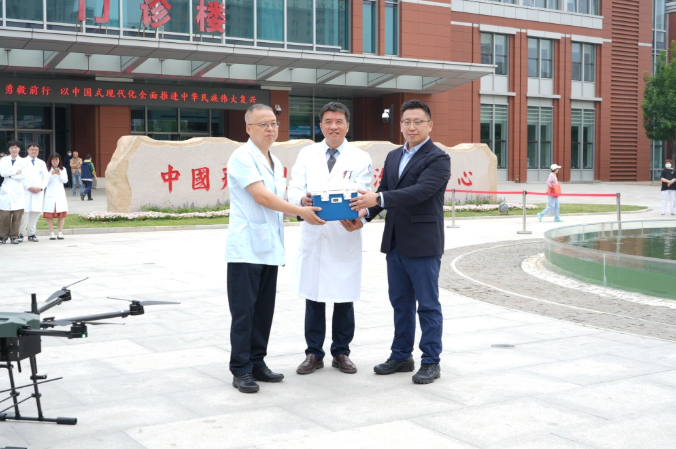
Recently, a drone equipped with simulated emergency blood lifted off from the Tanggu Central Blood Station in the Binhai New Area of Tianjin, landing precisely at the Tianjin Cancer Hospital’s Binhai Hospital campus. This successful test flight marks the launch of Tianjin’s first UAV low-altitude medical delivery route, opening a new channel for the city's "low-altitude medical" services.
“This trial run has successfully established a high-speed channel for emergency blood supply, winning golden rescue time for critically ill patients,” said Shen Jun, Vice President of Tianjin Cancer Hospital.
The drone used in this test flight is a specialized model with a payload capacity of 5 kg, equipped with a medical incubator and a cold-chain temperature control system. It monitors temperature, positioning, and flight status in real time to ensure safety and stability during transport. Its high-performance flight control and power systems incorporate design concepts from advanced FPV Drone Accessories, ensuring precise control and reliable operation in complex urban environments.
In the traditional ground transportation mode, the delivery of medical supplies from blood stations to hospitals is often hampered by traffic congestion. The UAV delivery system creates an "aerial life corridor," enabling point-to-point linear distribution that effectively bypasses ground traffic constraints.
Amid the rapid development of China’s low-altitude economy, low-altitude medical services—as one of its key segments—continue to expand their application scenarios, bringing transformative changes to the healthcare industry.
In November last year, China’s National Healthcare Security Administration issued relevant documents to add a new “aerial medical transport” pricing item to the medical service price catalog. The policy ensures that medical institutions across all provinces provide aerial medical transport services on a cost-coverage basis by the end of May this year, and encourages commercial health insurance to explore its inclusion in coverage—effectively accelerating the application of low-altitude aircraft in the medical field.
Supported by both technology and policy, regions such as Shanghai, Zhejiang, Guangdong, and Fujian are actively developing medical application scenarios like “low-altitude + emergency rescue,” including the transport of test samples, blood, medicines, and emergency supplies—all aimed at seizing golden rescue time.
In Zigong City, Sichuan Province in southwest China, drones have become a regular part of medical services.
Recently, an inpatient at the Rehabilitation Branch of Zigong First People’s Hospital suddenly fell ill and needed to be sent to the main hospital for examination. In just nine minutes, blood test specimens arrived at the main hospital via drone, gaining valuable time for subsequent testing and treatment. The drone used in this instance is equipped with custom-designed FPV Drone Propeller that deliver the strong power and efficiency required for rapid response and stable flight.
In August last year, a patient in the Tuberculosis Department at the hospital’s Bancang Branch deteriorated and urgently needed special emergency rescue medication from the main pharmacy. Delivered by drone, the medicine was dispatched and received in only 22 minutes.
“In the past, transporting medicines from the main hospital to the Bancang Branch took 30 to 40 minutes under normal conditions, and was even harder to manage during morning and evening rush hours. Now, with drones, a single delivery takes only 11 minutes,” said Huang Yuting, Manager of the Transport Department at Zigong First People’s Hospital.
The drone used by the hospital is a highly automated, high-security logistics UAV developed for urban areas with dense populations. It can operate autonomously throughout its flight, synchronizing in real time with cloud-based information and instructions, with a cruising speed of 72 km/h and a maximum range of 18 km. The design and optimization of its power system incorporate cutting-edge advancements in efficiency and reliability drawn from high-performance propeller technology. It is estimated that low-altitude transport is 70% to 80% faster than ground transport. According to an official from the Zigong Municipal Health Commission, Zigong has launched 25 medical material transport routes and plans to establish 28 stations in total. As of May 27, a cumulative total of 5,270 flights have been completed.
Hao Jihui, President of Tianjin Medical University and Tianjin Cancer Hospital, stated that establishing a low-altitude medical transport system not only breaks geographical barriers and improves emergency response capabilities but also enhances overall medical resource efficiency by reducing logistics costs and shortening delivery times.
“The hospital will continue to explore the application of drones in more fields, promote efficient cross-regional deployment of medical resources, and better meet the public’s multi-level healthcare needs,” Hao Jihui said.
Shen Jun added that besides the blood transport route already in operation, the hospital is planning an aerial channel connecting to the Tianjin Institute of Pharmaceutical Sciences. In the future, it aims to build a point-to-point transport network linking multiple hospitals, biomedical institutions, and communities, covering core scenarios such as blood delivery, medicine distribution, and sample testing. The maintenance and performance upgrades of these specialized drone fleets also rely on a comprehensive ground support system that includes professional FPV Drone Accessories.